How to declutter your wardrobe in a weekend (and actually finish)
You know what to do. You've probably known for years. So why does the wardrobe still look like that? Here's the honest answer, and the complete guide to finally sorting it.
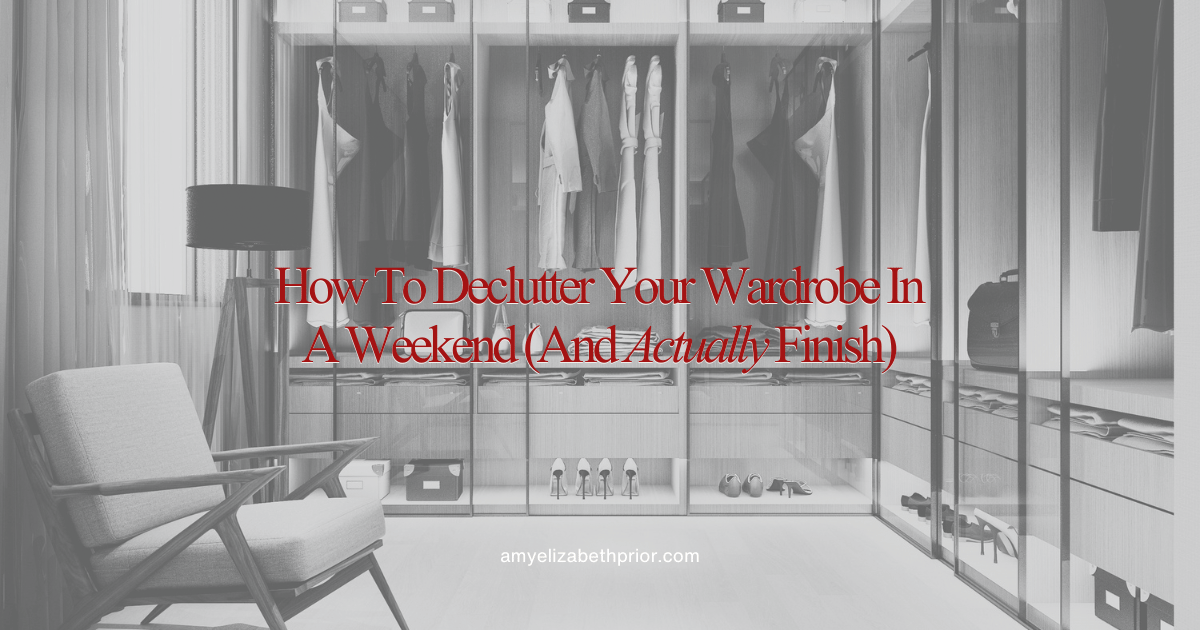
You have been meaning to sort your wardrobe for an embarrassingly long time.
Months, possibly. Maybe longer. Every Sunday evening you catch a glimpse of the rail and think “right, next weekend.” Next weekend arrives and somehow the wardrobe remains completely unhinged while you stand there at 7am in your underwear, pulling things off hangers, muttering under your breath, eventually settling for the same three things you always wear because at least you know where they are.
Sound familiar? Of course it does. You’re not disorganised. You’re not failing at adulting. You’re dealing with something that goes a lot deeper than a messy rail, and once you understand that, the whole thing becomes considerably easier to actually tackle.
I’m Amy Elizabeth Prior, professional organiser, decluttering expert, and the woman who has walked through more wardrobes than I care to count. In this post I’m going to walk you through exactly how to sort yours properly, not just a quick tidy that falls apart by Thursday, but a genuine reset that changes how you start every morning. And I’m going to tell you the bit that most decluttering guides don’t, which is why so many women still can’t quite get there even when they know exactly what they’re supposed to be doing.
First: why most wardrobe declutters don’t stick
Every January, millions of women pull things out of their wardrobes, fill a bin bag, feel amazing for about ten days, and then quietly watch the chaos rebuild itself. The pile reappears on the chair. The rail gets jammed again. The drawer that was briefly organised reverts to a crime scene.
This is not a willpower problem. It is not a storage problem. It is an identity problem, and it is the thing that nobody in the decluttering space wants to say out loud because it is considerably more confronting than “buy some velvet hangers.”
The clutter in your wardrobe is never really just clutter. It is the physical manifestation of every decision you have deferred, every standard you have lowered, every version of yourself you haven’t quite been able to let go of yet. That dress that cost a fortune and makes you feel inexplicably sad every time you see it. The jeans from six years ago you’re keeping “just in case.” The gifts you never liked but feel too guilty to move on. The interview outfit from the job you no longer do.
None of those things are taking up space in your wardrobe. They’re taking up space in your head. And your brain is registering every single one of them every time you open the doors, which is why getting dressed can feel so exhausting even before the day has started.
So before we get into the how, I need you to hear this: you can know every practical tip in existence and still find this genuinely, surprisingly hard. Not because you’re doing it wrong. Because the stuff isn’t just stuff. It’s the meaning underneath it. And that is a completely different problem with a completely different solution.
Right. Now we’ve got that out of the way, let’s talk about how to actually do it.
“The clutter in your wardrobe is never really just clutter. It’s the physical manifestation of every decision you’ve deferred and every version of yourself you haven’t quite let go of yet.”
What you’ll need before you start
None of this is glamorous, but skipping the prep is exactly how you end up with everything on the bed and no idea what you’re doing.
Strong bin bags or boxes for Sell, Donate, Repair, and Textiles. Post-it notes and a Sharpie. A camera or your phone for before and after photos, because once you’re in it you will completely forget how bad it was, and the contrast is genuinely the whole point. Somewhere to work, ideally a clear bed or floor space. And about three hours for an average sized wardrobe, though you might fly through it faster or prefer to spread it over the weekend. There is no prize for speed and no shame in splitting it into sessions.
Two minutes of prep now saves an enormous amount of faff later.
Step one: set the vision before you touch a single hanger
This is the part most people skip, and it is the part that makes everything else harder.
Before you pull anything out, I want you to close your eyes for thirty seconds and picture your wardrobe done. Not tidied for a week before it slides back to chaos, actually done. Doors open, everything visible, everything that’s in there fits you, suits you, and makes you feel like the woman you actually are right now or the one you’re in the process of becoming. Picture your mornings. No digging. No “nothing feels like me.” Open the door, choose something, get dressed, go. That is at least ten minutes of your day back, every single day, for the foreseeable future.
Hold that image. It matters more than you think, because every decision you make during the declutter should be filtered through it. If a piece doesn’t belong in that version of your wardrobe, it doesn’t belong in your wardrobe.
William Morris said “have nothing in your house that you do not know to be useful, or believe to be beautiful.” Wardrobe edition: if it’s not useful and it’s not gorgeous on you, out it goes. Ciao.
Step two: get everything out
All of it. Drawers, rails, hooks, the backs of doors, that “chairdrobe” you’ve been diplomatically pretending doesn’t exist. Pile it onto the bed or another flat surface, do a sweep of the rest of the house for any stray clothing hiding in the wild, and yes, it will look like a bomb’s gone off. That’s completely normal. It always looks worse before it gets better and this is genuinely the fastest way through.
If you know you get distracted easily, or you have a physical condition that makes working through everything in one sitting unrealistic, please don’t empty the whole wardrobe at once. Work through it one item at a time straight from the rail instead, doing focused fifteen to twenty minute bursts and coming back to it. Little and often gets you to exactly the same finished wardrobe. It just takes a different route.
Step three: make your decisions (this is where it gets interesting)
Pick up each item. Actually look at it. Try it on if you’re not sure. And then run it through these questions:
Have I worn this in the last year? Not “would I theoretically wear this.” Have I actually reached for it. Does it fit me now? Not the me from five years ago and not the me I’m hoping to become. Your wardrobe should fit the body you have today. And this one is important: seeing clothes that are too small is not motivation. Psychologically, it makes you feel worse about yourself every single morning, which statistically makes you want to eat biscuits and avoid getting dressed. Move them on.
How does it make me feel when I put it on? If the answer is “meh,” “gross,” or “so not me,” that is your answer. If I saw this in a shop today, knowing what I know now, would I buy it? If not, why is it still here? Does this still represent who I am, or who I’m becoming? Sometimes we hold onto clothes that represent an old job, an old relationship, an old version of ourselves that we haven’t consciously decided to let go of yet. It’s allowed to not fit anymore. You’re allowed to not fit it anymore. If I imagine my dream wardrobe, does this piece live there? Simple, but brutally effective.
Sort everything into Keep, Sell, Donate, Repair, and Textiles. Go with your gut. No one’s marking your homework.
The bits that will trip you up (and what to do about them)
Clothes with the tags still on. If it still has its tags after more than a year, you’ve voted with your feet. Something stopped you wearing it. Let it go. A sale item that was £200 reduced to £40 and hasn’t been worn isn’t a bargain. It was a lesson. They’re expensive, those lessons. Move it on and let someone else benefit from it.
The tatty pile. Holey knickers. Bobbled jumpers. Socks with no elastic. The bra you keep because “it’s comfy” even though it looks like it’s been through a tumble dryer approximately four hundred times. Out. All of it. And I mean this entirely seriously: if you are putting up with holey knickers, what else are you putting up with and tolerating in your life? Your standards start in the smallest places. Start here.
Guilt pieces. The dress from a holiday that just wasn’t you. The gift you never liked. Keeping something out of guilt doesn’t honour the person who gave it to you, doesn’t get your money back, and takes up space in both your wardrobe and your head. It can go.
And then there’s the sentimental stuff. This is where it gets genuinely hard. The pieces that feel impossible to let go of, not because you wear them, but because of what they represent. This is not a decluttering problem. This is an emotional one, and it requires a completely different approach to the rest. I’ve written a whole guide specifically on this Why You Can’t Break Up With Your Sentimental Clutter if you find yourself stuck here. It goes much deeper than a prompt list and it’s free.
Step four: organise what’s left
Group everything you’re keeping into categories: jeans, jumpers, dresses, skirts, PJs, underwear, and so on. This is the step most people rush because they want to get things back in, and it is also the step that determines whether your organised wardrobe lasts three weeks or three years, so please don’t skip it.
Clean the wardrobe while it’s empty. Vacuum the base, wipe down the shelves and rail with a damp cloth, and let it air completely before anything goes back in. While you’re doing that, plan where each category will live using Post-its. Write the category name on a Post-it and stick it where you think it should go. You can move them around without having to move actual clothes, which is a very small thing that saves a remarkable amount of time.
A few principles that make everything work better long-term: if you can’t see it, you won’t wear it, so everything visible rather than hidden where possible. Organise by category, then by colour within each category, darks to lights. What you wear most lives where you can reach it most easily. Daily pieces at eye level, at the front of the rail. Out of season, rarely worn, and occasion pieces at the back or in harder to reach spots. One category, one home. No rogue jumpers hiding in three different drawers. Make your life easy.
If you’re still using a mismatched collection of plastic and wire hangers, now is the time to replace them with matching slimline velvet ones. They free up to fifty percent of your rail space just by switching, everything stays in place, and your wardrobe instantly looks intentional rather than like a jumble sale. Non-negotiable in my professional opinion.
Step five: deal with what’s leaving
This is the bit that trips people up most, so please don’t skip it. Bag things up the same day you declutter, label them, and put them somewhere you’ll actually deal with them.
For selling: Vinted is brilliant for everyday clothes, shoes, and accessories. Depop for more fashion-forward or vintage pieces. Vestiaire Collective for designer and higher-end items. For donating: charity shops, Re-Fashion, Olio, local buy nothing groups on Facebook. For textiles too worn to sell or donate: most supermarkets and major retailers now have in-store textile recycling bins. Nothing needs to go to landfill.
The part nobody talks about: your morning after
When it’s done, take your after photo and put it next to your before. That contrast is genuinely the whole point and you will need it on the days when it feels like the tidiness might be unsustainable.
Then: put your laundry away as soon as it’s done. Hang outfits back up the day after wearing if they don’t need washing. Do it all little and often so it never becomes a mountain again. A wardrobe this organised is genuinely a joy to maintain. You will start your mornings differently. You’ll spend less money because you can actually see what you own. You’ll feel the weight lift every single time you open those doors. I promise.
Why knowing what to do isn’t always enough
Here’s the thing I said I was going to come back to, and I mean it.
You can read every wardrobe declutter guide in existence, including this one, and still find yourself standing in front of the rail six months later wondering why it’s all crept back. Not because the advice is wrong. Because the real work isn’t the sorting. It’s the stuff underneath the sorting. The stories attached to the clothes. The guilt. The grief. The version of yourself you’re not quite sure you’re allowed to leave behind yet. The buying habits that keep refilling the space you just cleared. The subtle belief that you don’t deserve a wardrobe that feels genuinely good to open.
That’s the work that makes the difference between a wardrobe clear-out and an actual reset. And it’s the work that most decluttering guides completely skip.
If you want the complete system (and a done-by-Monday deadline)
I created the Wardrobe Glow-Up Guide for exactly this. It is not just a list of tips. It is everything I know, in the order that actually works, including the parts that nobody else is talking about.
The guide covers the full declutter process step by step, the helpful questions for every item you’re stuck on, the guilt pieces, the sentimental pieces (and when to grab my separate free guide on those), how to organise everything back in properly, what to hang versus what to fold, the folding methods that actually work including file folding for drawers, lingerie and bra care, shoes and accessories, the backwards hanger trick, seasonal storage, caring for natural fibres, building a capsule wardrobe once you’ve cleared the decks, why timeless beats trendy (with the actual stats on fast fashion), colour analysis and why it changes everything, where to sell, donate, rent, and recycle everything that’s leaving, and a complete checklist so you never lose your place.
It also includes a scripting prompt so you can actually visualise and write down what your finished wardrobe feels like before you start, because that is not a nice-to-have. That is the thing that makes the decisions easier all the way through.
It is the guide I would hand you if you came to me for a one-to-one session. Everything I know. Everything I’d say. In the order that actually works.
Right now it’s £22 instead of £33. That is less than the last top you bought and never wore. The one that’s still in the wardrobe with its tags on. The one you just read about in the section above.
You could have a completely sorted, organised, genuinely lovely wardrobe by Monday. Not a slightly tidier version of the current chaos. An actual reset.
Add the code: GLOWUP11 at checkout.
And if you want to go further than the wardrobe…
The wardrobe is always just the beginning. It’s the first place I send women because it’s contained, it’s achievable in a weekend, and the shift you feel when it’s done is genuinely disproportionate to the effort involved. But it is a doorway, not a destination.
If you’re at the stage where you can feel that the wardrobe is part of something bigger, that the chaos in your home and your head and your life are all connected, that is not your imagination. They are. And that bigger work is what I do inside Break Up With Your Stuff, my programme combining practical decluttering, identity work, mindset, habits, and real accountability for women who are done with temporary fixes. Join the interest list here and I’ll let you know when the next round opens.
And if you want to hear me talk about all of this in far more depth than a blog post allows, come and listen to the How to Break Up With Your Stuff podcast.
Your Brain Isn't the Problem. Your Systems Are!
Break Up With Your Stuff is a complete life reset for women who are done with chaos. Practical decluttering, identity work, ADHD-friendly systems, mindset, and real accountability; all in one place.
Want something more intensive and personal? Find out about working with me 1:1 on the coaching page.
Amy Elizabeth Prior
Amy Elizabeth Prior is a decluttering expert, identity coach, and founder of Break Up With Your Stuff. She has combined-type ADHD, was diagnosed as an adult, and spent years figuring out how to build systems that actually work for a brain that doesn't respond to standard organisation advice. She now helps ambitious women transform not just their homes, but their relationship with themselves.