Why I Swear By Manifestation Journaling (And How It Helps Me Manifest)
For years I dipped in and out of journaling without really understanding what I was doing or why it wasn't working. Now I genuinely cannot not do it. Here's what changed.
I’ll be honest with you, like many women, I spent years being completely confused about journaling.
I’d start, write a bit, or not, overthink it, convince myself I was doing it wrong, and stop. Then a few weeks later I’d start again. I felt a bit of a pillac about it because I thought, surely I should know how to do this? It’s literally just writing things down. What is the actual problem?
But I just didn’t get it, and that confusion, I’ve since realised, was because I didn’t understand that there are actually different types of journaling and they do completely different things. Once all of that clicked, everything changed.
But first, let me tell you a quick story, it’s one of my favourite examples of manifestation (and the divine delays) in action.
At some point in 2025, I came across a glorious journal on Instagram and instantly thought, *I’d LOVE to collaborate with that brand one day.* I put it out into the universe, fully decided it was happening… and then I completely forgot about it.
Months later, mid 2026, just before this personal brand website was due to go live, I was tinkering a few things on the shop page whilst checking edits for my developer, when I noticed there was a placeholder image for a journal. It suddenly reminded me of that brand. I remember thinking, *I really need to get in touch and make that collaboration happen.*
Then, because I have ADHD and the attention-switching abilities of a raccoon on meth, with a to-do list longer than the M25, I got distracted and never did.
No word of a lie, that was on the Thursday evening. On the Monday morning I opened my inbox to find an email from the brand asking if **I’d** like to collaborate with **them**. They’d been following my content, felt our values were completely aligned, and wanted to work together!
The funny thing is, I wasn’t even surprised.
That’s the thing about manifestation. Just because you can’t see evidence of something happening yet doesn’t mean nothing’s happening. In reality, 2025 would’ve been a dreadful time for that opportunity. My business was flat out, well over capacity with coaching clients, a rebrand was on the horizon, and I simply didn’t have the time to do it properly. It arrived exactly when it made sense, not when I first asked for it.
That’s one of the biggest lessons manifestation has taught me: your job is to become clear about what you want and believe it’s done. The timing isn’t yours to control.
Anyway… back to journalling.
Now I journal every single night without fail.
Even if I’ve been working late. Even if I’ve been out for dinner and had a few drinks. Even if it’s past midnight and my handwriting looks like it was written by someone with their non-dominant hand during an earthquake. I genuinely cannot not do it. If I’m staying somewhere overnight I pack it. If I’m exhausted I still do it. It takes minutes and the impact is completely disproportionate to the effort involved, which is my favourite kind of thing.
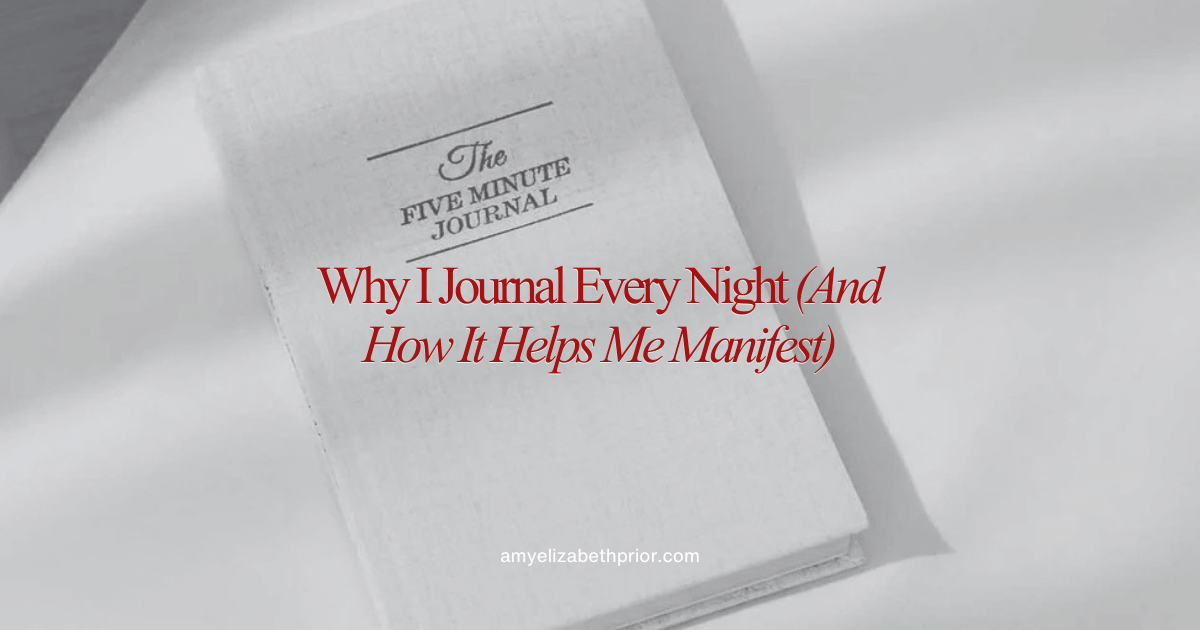
So I want to talk about what journaling actually is (both kinds), why it works in ways that go far beyond “it makes you feel a bit nicer about your day,” and the journal that’s made my daily gratitude practice so much easier and more consistent: the Five Minute Journal by Intelligent Change, which I’ve been gifted in linen and is completely gorgeous.
The two types of journaling (and why most people only know about one)
When most people think about journaling, they think about the “dear diary, today I had pasta” variety. Processing your day, getting things out of your head, maybe having a little cry into your notebook. And that kind of journaling, what I’d call real-time or reflective journaling, is genuinely useful and we’ll get to it, but it’s only half the picture.
The two types are reflective journaling, which is checking in with yourself, processing what’s actually happening, and untangling the thoughts that might be keeping you stuck, and manifestation journaling (or scripting, I use both terms interchangeably). Scripting is writing down your dreams, goals or desires as if they’ve already happened, fully embodying the future version of you who already has what you want and writing from that place.
The second one is the one I do most. It’s the one that has produced the most tangible, sometimes quite jaw-dropping results in my life, and it’s the one most people have never really tried properly because it feels a bit strange and a bit audacious and, let’s be real, a bit delulu… until you’ve seen it work enough times that you can no longer pretend it’s a coincidence! If you’ve worked with me before, you’ll know exactly what I mean.
Reflective journaling: your tool for awareness
Reflective (or real-time journaling) is about getting things out of your head and onto paper where they can stop swirling around like a mental, rumination and procrastination storm. It absolutely does not need to be fancy, it doesn’t need to follow a specific format, and you 100% do not need a leather-bound notebook and a calligraphy pen to do it properly. Grab whatever you’ve got, ask yourself a few honest questions, how am I actually doing today? What’s working? Where am I stuck? Am I thinking from fear or lack or from possibility and abundance? and just let it come out. Don’t edit it, don’t overthink it, nobody else is reading this.
The simple act of writing creates a kind of mirror.
It’s a bit like having an unpaid coach or therapist on call at whatever time you need one, because you start to notice patterns you genuinely hadn’t seen before, things like “I’ve replayed one awkward five-minute conversation so many times you’d think it deserved a BAFTA.”” or “no wonder my husband isn’t showing up, I’ve been assuming there are no decent single men left on the planet” or “the reason I haven’t a pot to p*ss in is because I’ve been wedded to the false belief that money is the root of all evil.”
Psychologists call this cognitive offloading, which is essentially what happens when you get thoughts out of your head and down on paper.
Your brain stops having to hold all of it, the overwhelm reduces, clear thinking becomes more accessible, and emotional regulation improves. Multiple studies have shown that journaling reduces stress, boosts mood, and improves cognitive function. It is not busy work. Busy work is editing your perfectly good-to-go Canva PDF for 3 hours straight. This is the work that makes the outer work actually stick.
I don’t do this type of journaling every day anymore, but I come back to it in specific situations: when I’m trying to untangle something, when I feel triggered, or throughly livid about something I can’t quite understand, after a tapping session when something has surfaced, or when I just cannot shake a block around a particular area of my life, whether that’s my home, business, a relationship, money, or showing up somewhere I’ve been avoiding.
It’s how you stop unconsciously self-sabotaging and start actually moving forward, because staying stuck in overthinking without ever processing what’s underneath it is just a particularly slow, annoying and exhausting way of going absolutely nowhere.
Manifestation journaling and scripting: why I am totally wild about this… (and will passionately promote it until my last breath)
This is the thing that changed my life in a way I find totally INSANE when I look back through old journals.
Manifestation journaling, or scripting, is not writing what’s real right now. It’s writing what you want to bring into your reality, but writing it as if it has already happened. Present tense. Gratitude. Assumed. So instead of “I’m so skint. I wish I had more money,” which is coming from lack and desperation, you write “I’m so grateful money flows to me with ease. I always have more than enough, I see opportunities and make smart decisions with it, I feel completely safe and supported financially.”
Or, instead of, “I wish my house was tidy,” you write, “I’m so grateful I walk into a calm, organised home that feels beautiful, peaceful and completely reflects the woman I’ve become.”
Or instead of, “I just wish I could lose weight,” you write, “I’m so grateful I feel strong, healthy and completely at home in my body. I trust myself, I look after myself, and I love the way I feel.”
For years I worried about this…
Once I started understanding manifestation and seeing it work in my own life, I thought, if I journal about the hard stuff, am I just going to attract more of it? I genuinely stressed myself out about it. But here’s what I eventually understood: you do need to process what’s going on, otherwise you’re just burying your head in the sand, and unprocessed emotions don’t disappear, they trip you up later, usually at the worst possible moment. So the two types work together. Real-time journaling for processing the reality you’re in. Scripting for creating the reality you’re moving towards. You need both.
I do my manifestation journaling in the evening now, just before bed, though I used to do it in the mornings, but they got too hectic with a tiny boss child!
Some evenings I write for a minute. Other times I’ll sit there for fifteen or twenty minutes going into a full story about whatever I’m trying to bring in. Sometimes I write about smaller immediate things, like a specific conversation going well or finally finishing something that’s been hanging over me for weeks. Other times I go bigger and write about the longer-term or more ‘outrageous’ vision. There’s no right way to do it. The only rules are present tense, gratitude, and always go to the best case outcome rather than the catastrophe your amygdala is secretly drafting in the background.
The reason scripting works isn’t just vibes, by the way.
When you repeatedly write a desire as if it’s already happened, you’re forming new neural pathways that make that belief feel progressively more normal to your brain, which is neuroplasticity and it is genuinely real. Your reticular activating system, (RAS) the filter in your brain that decides what to notice and what to ignore, starts scanning for evidence that matches what you’ve been writing…
Opportunities that were always there start getting noticed. Doors open. The right people turn up. You find a £20 note on the floor! Whatever… Things start lining up.
“I’ve gone back through old scripting journals and found things that have happened since, sometimes to the letter, sometimes months later. I stopped thinking it was coincidence a long time ago.”
On perfectionism (because someone always asks about this)
Some of the women inside Break Up With Your Stuff recently asked about completing the Life Upgrade Audit, and the questions were almost all some version of the same thing: what if I want to add something in later, won’t it look messy? How should I add it in? Where do I write it?
I’ve been there darling. I did this for years. And what I want you to hear is that the perfectionism is not really about the journal! It’s your old identity trying to keep you safe inside a comfort zone disguised as standards. Perfectionism and procrastination are very often the same thing wearing classier clothes, and the journal does not care if your handwriting is messy. The universe definitely doesn’t. The version of you that you’re building through this practice isn’t derailed by a slightly untidy entry from a Wednesday night when you were tired. Pick it up, write something, and keep going.
But first: you don’t need the perfect notebook to start
If you want to start today, genuinely just grab some paper, the back of a receipt or envelope you haven’t yet binned, or one of your kids 857 pieces of artwork. A notebook you’ve got lying around, even the notes app on your phone if you’re really not fussed about the tactile side of it. You get the picture… Don’t let not having the perfect journal stop you from starting, because that is just the perfectionism I was just talking about, wearing a slightly more convincing outfit.
Start there. Build the habit. See how it feels.
And then, if you do want something that’s simply gorgeous as well as brilliantly structured, let me tell you why the Five Minute Journal has been such a good addition to my practice…
Why I love the Five Minute Journal specifically
I’ve been doing my own manifestation journaling practice for a long time, but actively practising gratitude in a structured, specific way, really naming the small particular things I’m grateful for rather than just broadly feeling it, is something I hadn’t been particularly intentional about. The Five Minute Journal is designed to do exactly that: build a consistent, structured gratitude practice in, as the name suggests, five minutes. It’s backed by real positive psychology research, including studies by Emmons and McCullough on the benefits of daily gratitude practice and Crum and Langer on mindset priming, and the format is genuinely clever.
Each morning there are three prompts: three things you’re grateful for, what would make today great, and a daily affirmation. Each evening you reflect on three amazing things that happened and answer one question, how could I have made today even better? That’s it. The whole thing takes about two to three minutes in the morning and two minutes at night, which removes the blank page problem completely and means there’s zero decision fatigue about what to write or how to structure it. You just open it and answer!
The linen edition is a sensation and right up my street aesthetically, which can seriously help when you’re building a new habit! (Yes, I can hear my own anti-perfectionism lecture in the background as I write this.) But, there’s something about having an item that feels considered and beautiful sitting on your bedside table that makes you actually want to pick it up.
It’s also undated, which I think is one of the smartest design decisions they made. No pre-printed dates means you can’t “fall behind.”
You pick it up when you pick it up, skip a few days when life happens, and start again from where you are with absolutely no guilt built into the format. As someone with ADHD who is very much all or nothing, and has dramatically fallen off habits before and then felt terrible about it, I appreciate this more than I can say!
Over three million people have used the Five Minute Journal worldwide since Intelligent Change launched it in 2013, it comes with a six-month money-back promise, and the reviews are consistently excellent. This isn’t a niche wellness trend. It’s one of the best-known guided journals in the world.
And if you’ve followed me for any length of time, you’ll know I’m incredibly selective about the brands I work with. I’m simply not available for peddling things I wouldn’t be happy to recommend, which is exactly why you’ll only ever see products here that genuinely align with how I live, work and think.
How I use both together
My current evening practice is the Five Minute Journal for the structured reflection and gratitude prompts, followed by my own freeform scripting for what I’m calling in. The whole thing takes as long as I want, I do it before I sleep, and it is as automatic as brushing my teeth. Actually more automatic than brushing my teeth on some days, which probably says something about my priorities but here we are!
If you’re newer to journaling or you’ve tried and kept falling off, start with the Five Minute Journal alone before adding in scripting. The structure removes the overwhelm, the format removes the blank page problem, and five minutes is achievable on even the most chaotic of days. Build the habit first, then layer in whatever else serves you.
Where to get it
You can grab the Five Minute Journal directly from Intelligent Change. Use code AMYELIZABETH10 at checkout for 10% off.
I’ll be talking more about journaling, scripting, and all the mindset work that underpins the identity stuff I do on the How to Break Up With Your Stuff podcast. Come and have a listen here.
And if you’re at the stage where the inner work feels important but you want proper structure and accountability for doing it alongside decluttering your home, your habits, and your identity all at once, Break Up With Your Stuff is exactly that. Join the interest list here and I’ll let you know when the next round opens.
If you’ve got this far, I’d love to know… had you ever heard of manifestation journaling (or scripting) before reading this? Or was this your biggest “aha!” moment? Drop me a DM on Instagram @amyelizabethprior and let me know. I read every single message, and I absolutely love hearing what resonates most with you!
Your Brain Isn't the Problem. Your Systems Are!
Break Up With Your Stuff is a complete life reset for women who are done with chaos. Practical decluttering, identity work, ADHD-friendly systems, mindset, and real accountability; all in one place.
Want something more intensive and personal? Find out about working with me 1:1 on the coaching page.

Amy Elizabeth Prior
Amy Elizabeth Prior is a decluttering expert, identity coach, and founder of Break Up With Your Stuff. She has combined-type ADHD, was diagnosed as an adult, and spent years figuring out how to build systems that actually work for a brain that doesn't respond to standard organisation advice. She now helps ambitious women transform not just their homes, but their relationship with themselves.